NASA's Lunabotics Challenge reveals the limits of robot autonomy
Fifty college teams converge at Kennedy Space Center this week for NASA's 2026 Lunabotics Challenge — and the task their robots must perform is one of the hardest problems in robot autonomy: unstructured construction in a variable, loose-substrate environment.
The robots must autonomously build berms — protective barriers — from BP-1, a simulated lunar regolith. On the Moon, those berms would shield Artemis infrastructure from debris during landings and launches, insulate cryogenic propellant tanks, and protect nuclear power systems from radiation. This is not a demo problem. The teams are prototyping solutions NASA will use to evaluate readiness for actual mission infrastructure.
"The task of robotically building berm structures will be important for preparation and support of crewed lunar missions." — Kurt Leucht, NASA software developer and ISRU researcher, Kennedy Space Center
Autonomous construction in loose, unpredictable terrain is largely unsolved in earthly robotics too. Warehouse robots operate on flat, mapped surfaces with known friction. Construction robots work in structured sequences on prepared ground. Lunabotics removes both constraints: the surface is variable, the task requires adaptive planning, and there is no human operator correcting each pass. That is where the hard engineering lives — and it is the same boundary that limits robot deployment in terrestrial construction, agriculture, and disaster response.
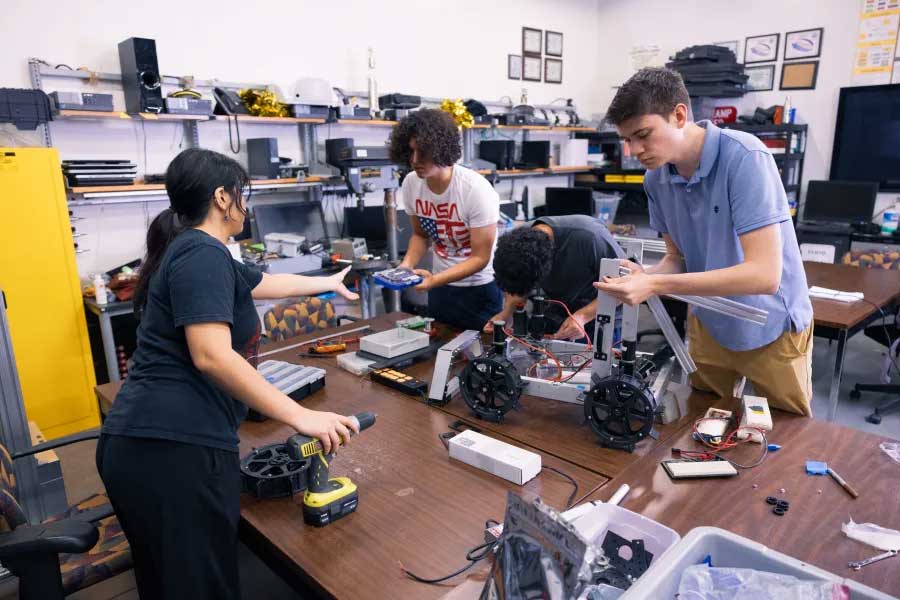 University students work on their Lunabot rover at NASA's Kennedy Space Center during the Lunabotics Challenge
"These competing teams are not only building critical engineering skills that will assist their future careers, but they are literally helping NASA prepare for our future Artemis missions to the Moon," said Kurt Leucht, NASA software developer and In-Situ Resource Utilization researcher at Kennedy. The framing matters. NASA is distributing a hard construction-autonomy problem across 50 institutions and collecting real design data — not awarding a scholarship and moving on.
The challenge has run since 2010. That means there is now a substantial cohort of engineers whose early careers were shaped by working through autonomous construction at the boundary of what current systems can do. The 2025 competition was won by the University of Utah. This year's event runs May 19–21, with live streams available each day on YouTube.
The berms these robots build this week will not reach the Moon. But the engineering capability and design evidence NASA is gathering will be load-bearing by the time Artemis missions require it — and the teams solving it now are developing instincts for a class of problem that terrestrial robot deployments have not yet cracked.
The 2026 Lunabotics Challenge runs May 19–21 at the Center for Space Education, Kennedy Space Center Visitor Complex, Florida. Watch live each day at 8 a.m. Eastern:
Source: NASA Media Advisory M26-001