Most humanoid startups have never deployed a robot. Robot.com has deployed 500.
The humanoid race is crowded with companies that have never run a robot in a building they don't own. Robot.com is not one of them. The San Francisco startup — formerly Kiwibot — has more than 500 robots in the field and 2.5 million completed tasks behind it, and on June 22 it used that operating history to launch R-noid, a wheeled humanoid built for the repetitive work that wears people down. For most humanoid entrants, the hard part is still ahead. For this one, it is largely behind.
Deployment experience is the part you cannot demo
Most humanoid announcements are demo reels: a robot folds a shirt, sorts a bin, walks a treadmill. What the reel never shows is the part that decides whether a robot survives contact with a real workplace — the maintenance schedule, the remote-operations desk, the data pipeline, the person who drives out when a unit wedges itself against a loading dock at 6 a.m. Robot.com built that apparatus over eight years of running delivery robots on college campuses and city streets, across the US, Canada, and Dubai.
That is the argument for taking this launch seriously. CEO Felipe Chavez frames the humanoid as an extension of infrastructure the company already runs, not a leap into a new business.
"We have built operations, maintenance, remote operations, remote service desk, data infrastructure, and business development infrastructure. We already know what it takes to deploy robots." — Felipe Chavez, CEO, Robot.com
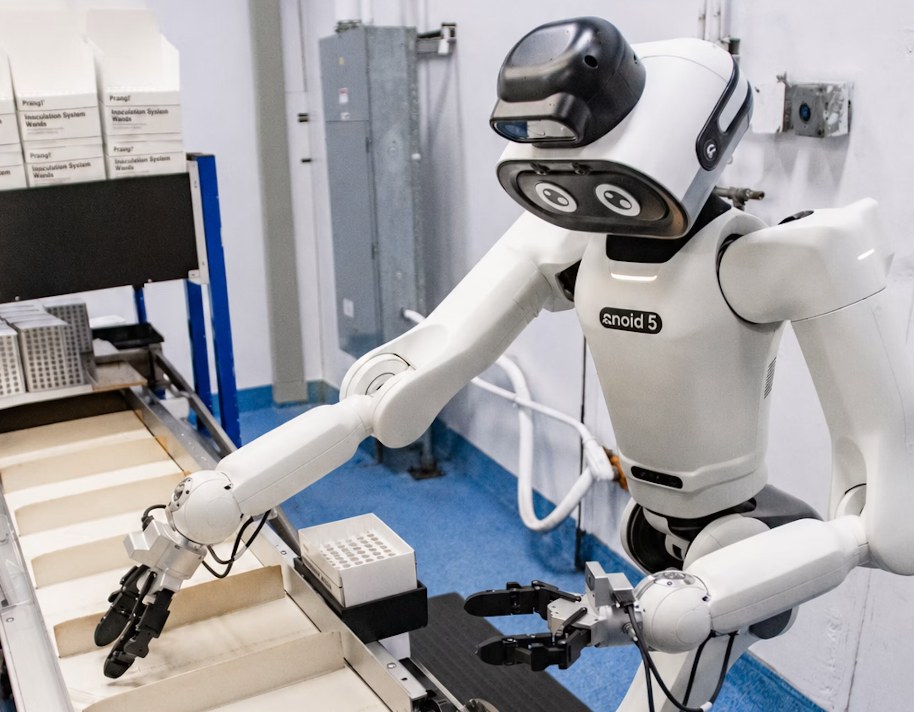
Image: Robot.com
Robot profile: R-noid
Manufacturer: Robot.com (San Francisco, CA), formerly Kiwibot Form factor: Wheeled humanoid — holonomic mobile base, no legs Height: 1.7 m | Base diameter: 0.55 m | Weight: 90 kg Arms: Dual 7-DOF | Payload: 4 kg per arm Vertical workspace: 0–1.9 m | End effectors: Modular, hot-swappable Power: ~3 hours runtime per charge Operating modes: Autonomous and VR teleoperation (~70% autonomy at initial deployment) AI system: Manipulation via Physical Intelligence's π0.7 vision-language-action model; FieldAI Field Foundation Models for navigating unfamiliar spaces; NVIDIA Jetson onboard compute, validated in Isaac Sim Interaction: R-Soul OS — on-board expression system, LED display, and conversational voice Deployment: 8–12 weeks from site visit to operation; up to 50 hours of task data collected for complex jobs Business model: Robot-as-a-Service (subscription, not hardware sale) Initial roles: Restaurant assistant, packer, picker, folder, host Fielded to date: Fewer than 40 units across roughly a dozen customers, including Harbor Links Golf Course (NY)
Wheels are a feature, not a compromise
R-noid does not walk, and that is the right call. A holonomic wheeled base removes the entire cost of bipedal balance — the gait control, the fall recovery, the compute spent on staying upright — and spends it on the part customers actually pay for: arms that move boxes, plate orders, and prep workstations. Diligent Robotics has run wheeled robots in hospitals for years; Sunday Robotics and Genesis AI are demonstrating the same bet. The form follows the warehouse and the kitchen as they exist, not a humanoid ideal.
The autonomy claim is honest, too. Robot.com expects roughly 70% autonomy at the start of a deployment, with teleoperators covering the rest while the model fine-tunes on facility-specific data. That is a working system describing itself accurately, not a launch video implying full independence.
The deployment is small, and that is the point
Fewer than 40 R-noids are in the field, across about a dozen customers — including Harbor Links Golf Course in New York, where one loads food into delivery robots and helps staff pack orders. That is a deliberately narrow start. The company visits a facility, identifies which tasks are worth automating, and collects up to 50 hours of task data before a robot goes live. Eight to twelve weeks per site is not a press-release number; it is the cadence of a company that has already learned what rushing a deployment costs.
A founder who arrived with no contacts and no English
The discipline traces back to its founder. Felipe Chavez built his first company, Lulo, as a student delivery service in Colombia, and sold it to the Latin American unicorn Merqueo. He then moved from Medellín to Silicon Valley roughly a decade ago — by his own account without industry contacts and without strong English — to raise money for a robotics company most investors had no framework for funding. Colombian angel backers financed the move. The first Kiwibot pilot rolled across the UC Berkeley campus in 2017.
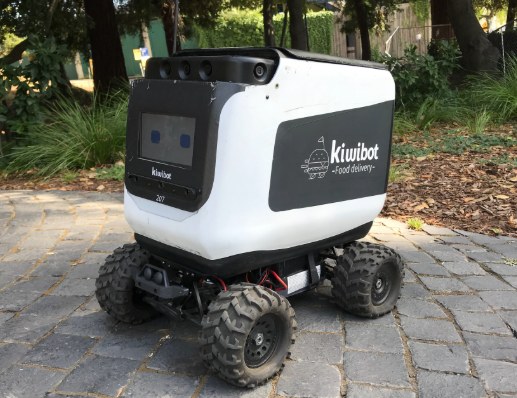
Image: Robot.com
That origin matters because it shaped the company's instincts. A founder who had to earn every dollar of early capital without a network does not build a business on demo-day spectacle. He builds one on robots that show up, do the work, and come back the next day — which is exactly the standard R-noid will be held to.
"Robots today, not someday." — Felipe Chavez
The humanoid field will be won by whoever can keep a fleet running in someone else's building, week after week, long after the launch video stops trending. Robot.com has been doing that unglamorous work for eight years. R-noid is not a bet that the company can build a humanoid — it is a bet that the company already knows the hard part everyone else is about to discover.
Header and card images: Robot.com.