SoftBank wants 1X because Japan's robot advantage was built for factories.
SoftBank's reported pursuit of 1X Technologies is not just another bet on a humanoid robot. It is a bet that the next robotics platform will be trained in homes, financed like AI infrastructure, and scaled by companies that understand software, data, and distribution as well as motors and gears.
That distinction matters. Japan has one of the deepest robotics cultures in the world. Its factories helped define modern automation. Its companies built the arms, controllers, components, and manufacturing discipline that made industrial robotics real. Yet the machine SoftBank appears to want now is not a better welding arm or a more expressive greeter in a retail store. It is a soft-bodied humanoid designed to enter private homes, learn domestic routines, and convert messy household behavior into a deployment flywheel.
According to Reuters, citing The Information, SoftBank is in talks to buy a majority stake in OpenAI-backed 1X Technologies at a valuation of about $6 billion. The terms could still change. But the strategic logic is already visible.
SoftBank is trying to own the bridge between AI and the physical world.
The deal is about the home, not the humanoid
1X is attractive because it is aimed at the hardest commercially interesting environment in robotics: the home. Factories are structured. Warehouses can be redesigned around robots. Homes resist standardization. Every kitchen drawer, laundry pile, floor surface, pet, child, cable, chair leg, and social expectation creates a different operating condition.
That is exactly why the home matters.
1X describes NEO as a home robot for chores and personalized assistance. Its order page lists a $499-per-month subscription option, a $20,000 ownership option, a $200 refundable deposit, and U.S. deliveries beginning in 2026. The product is not only a robot body. It is an attempt to make the household into a recurring service market.
For SoftBank, that is the prize. A successful home humanoid is not a single device sale. It is a platform for embodied data, remote assistance, fleet learning, subscription revenue, maintenance, insurance, app ecosystems, and eventually household operating systems. If phones turned pockets into software platforms, home robots could turn domestic space into the next AI interface.
That is still a huge "if." But SoftBank has rarely been shy about buying early into the version of a market that sounds absurd before it becomes inevitable.
Japan's robotics strength was optimized for a different world
The uncomfortable question is obvious: why would a Japanese giant need a Norwegian-American robotics company when Japan has spent decades as a robotics superpower?
The answer is that Japan's robotics advantage was built around industrial excellence, not consumer autonomy.
The International Federation of Robotics' World Robotics 2025 report says Japan remained the second-largest industrial robot market in 2024, with 44,500 units installed and 450,500 industrial robots in operation. Japan's robotics base is formidable. But industrial robotics rewards repeatability: fixed workcells, known objects, controlled lighting, trained operators, safety cages or well-defined collaborative zones, and ROI models tied to production.
Home robotics rewards almost the opposite: ambiguity, softness, adaptation, low supervision, emotional restraint, privacy, and an ability to fail gracefully in front of people who did not sign up to become robot technicians.
That is not simply a hardware problem. It is a product, AI, data, service, and trust problem. Japan has world-class robot makers, but the country has not yet produced the dominant AI-native domestic robot company. The gap is not a lack of mechanical skill. It is that the center of gravity has moved.
Pepper taught SoftBank what not to buy
SoftBank has already lived through the first wave of social robot optimism. Pepper was introduced with enormous cultural confidence: a friendly humanoid, built to read emotion and appear approachable in stores, lobbies, and public spaces. It became a symbol of Japan's robot imagination.
It also became a warning. In 2021, reports said SoftBank had stopped production of Pepper amid weak demand. The lesson was not that humanoids are useless. The lesson was that charm is not utility.
Pepper could create attention. It could not create enough durable work.
1X is interesting because it starts from a different premise. NEO is not pitched primarily as a companion, entertainer, or brand ambassador. It is pitched as labor inside the home. That changes the evaluation standard. A home robot will be judged by whether it can tidy, carry, fetch, clean, fold, notice, wait, recover, and coordinate with human routines. The bar is higher, but so is the market if it works.
SoftBank's strategy appears to be a correction from symbolic robotics toward useful robotics.
ABB gives SoftBank the factory layer; 1X would give it the household layer
The 1X talks also make more sense when placed next to SoftBank's agreement to acquire ABB's robotics business. In October 2025, SoftBank announced a $5.375 billion agreement to buy ABB Robotics. ABB said the transaction was expected to close in mid-to-late 2026, subject to regulatory approvals and customary conditions.
ABB gives SoftBank an industrial robotics base: customers, engineers, installed systems, control knowledge, manufacturing relationships, and credibility in the world where robots already produce economic value.
1X would give SoftBank a different asset: a home-first humanoid thesis, an AI-native team, an OpenAI-linked history, a consumer deployment story, and a body designed for unstructured environments.
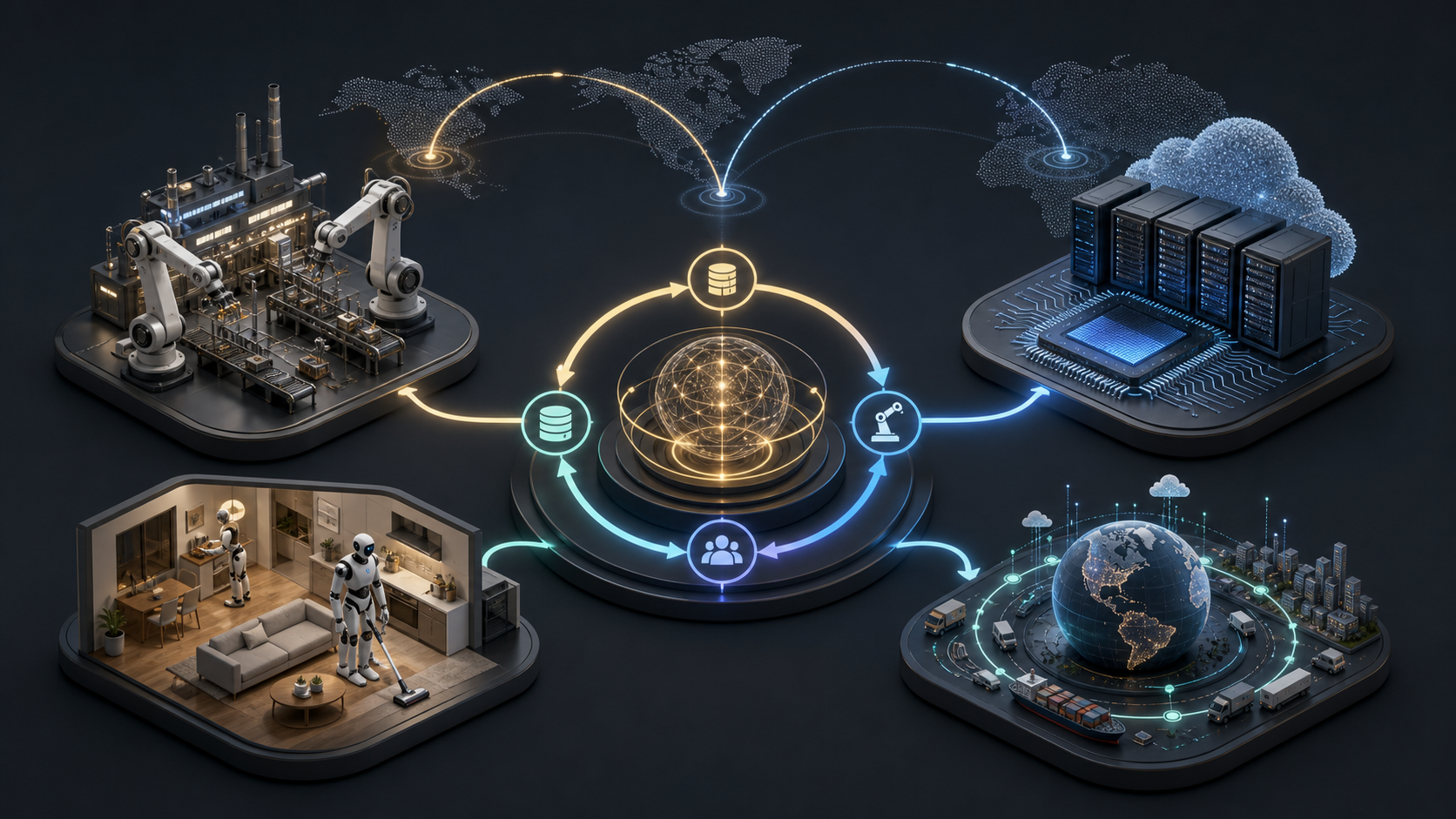
Together, the shape is clear. ABB is the old robot economy: factories, arms, precision, production. 1X is the speculative new robot economy: homes, humanoids, embodied AI, household data, service subscriptions. SoftBank is not choosing between them. It is trying to own both ends of the transition.
That is a more coherent strategy than it first appears. Industrial robotics can generate near-term revenue and manufacturing discipline. Domestic humanoids can generate the long-term platform option. AI compute, OpenAI exposure, Arm, data centers, and robotics then become pieces of the same physical AI stack.
Why acquire instead of build in Japan?
Building a domestic 1X inside Japan would be slower than buying the company that has already made the dangerous product decisions.
1X has chosen a soft humanoid form factor. It has leaned into the home before the home is a proven category. It has accepted the messy privacy, teleoperation, autonomy, and service-model questions that come with early household deployment. It has built a brand around domestic usefulness rather than industrial performance.
Those are not obvious choices for a traditional Japanese robot manufacturer. The Japanese robotics industry has been shaped by manufacturing customers, component precision, safety conservatism, and incremental reliability. Those strengths are valuable, but they can also make a company hesitate before putting an unfinished AI robot into a consumer learning loop.
The U.S. AI ecosystem and Nordic robotics culture gave 1X a different permission structure. Move early. Collect embodied data. Design for human contact. Put the robot in the home. Improve through use. Treat autonomy as a product roadmap, not a prerequisite for the first customer relationship.
SoftBank can provide what 1X lacks: capital, patience, Asian manufacturing relationships, telecom and services knowledge, and a global strategic umbrella. 1X can provide what Japan has not yet produced at scale: a credible home humanoid platform that is already organized around AI-native deployment.
The strategy is physical AI vertical integration
Masayoshi Son's larger thesis is that AI will not stop at chat, search, coding, or enterprise software. It will need bodies, sensors, actuators, factories, energy, chips, connectivity, and real-world feedback. Robots are where AI touches the economy directly.
That is why a 1X deal would not be just a robotics deal. It would be a vertical-integration move across the physical AI stack:
- AI models supply reasoning and perception.
- Arm, chips, and data centers support compute.
- ABB supplies industrial robotics depth.
- 1X supplies domestic embodiment and household data.
- SoftBank supplies capital, patience, and strategic coordination.
The risk is equally large. Home robots could remain expensive, limited, teleoperated, privacy-sensitive, and operationally fragile for years. The first wave may disappoint consumers before the second wave matures. If SoftBank overpays for narrative before utility, it could repeat the emotional arc of Pepper at a much higher valuation.
But the logic is sharper this time. Pepper was a robot looking for work. 1X is trying to make work the center of the product.
The real question is who owns the learning loop
The strategic asset in domestic robotics will not be the first robot that looks humanoid. It will be the company that owns the learning loop between households, operators, AI models, robot bodies, safety systems, and service workflows.
That is why SoftBank wants in. If 1X succeeds, it does not merely sell a robot into the home. It begins to map domestic labor at machine scale. It learns how people actually ask for help, where robots fail, which chores are economically meaningful, what privacy boundaries matter, and how physical AI improves when deployed around real people.
Japan did produce the robot age that filled factories. It did not yet produce the robot age that enters homes. SoftBank's reported move for 1X is an admission of that gap and an attempt to close it by acquisition.
The bet is simple, expensive, and very SoftBank: if physical AI becomes the next platform shift, the winner will not be the company with the cutest robot. It will be the company that can turn intelligence into repeatable action in the real world.