Humanoids are here. The service industry is not ready.
Southwest Airlines issued a companywide safety alert banning human-like and animal-like robots from the cabin and checked baggage two days after a 3.5-foot humanoid named Stewie flew from Las Vegas to Dallas Love Field with its own purchased seat. The ban came fast. The reasoning was thin. And the scenario it was responding to is not going away.
The flight itself is the signal
Aaron Mehdizadeh, owner of The Robot Studio in North Dallas, flew Stewie home from Las Vegas on a standard instrument seat — the kind typically used for cellos and fragile equipment. To clear TSA, the robot was fitted with a smaller lithium-ion battery comparable to a laptop battery. It walked through the airport. It boarded. Passengers photographed it. Flight attendants stared. Nothing broke. The flight worked operationally because Mehdizadeh understood the constraints and engineered around them — not because any policy existed to handle the situation.
Southwest's rationale doesn't hold
Southwest cited lithium-ion battery safety guidelines as the basis for the ban. Mehdizadeh disagrees directly: the battery was equivalent to what passengers carry in their laptops on every flight. He has said publicly that he hopes Southwest will reconsider once robots meet defined safety requirements. The problem isn't the battery. The problem is that Southwest had no framework for evaluating the battery — or the robot — in real time. The ban is the fastest version of a policy response. It is not the last version.
The robot: Stewie on the Booster K1
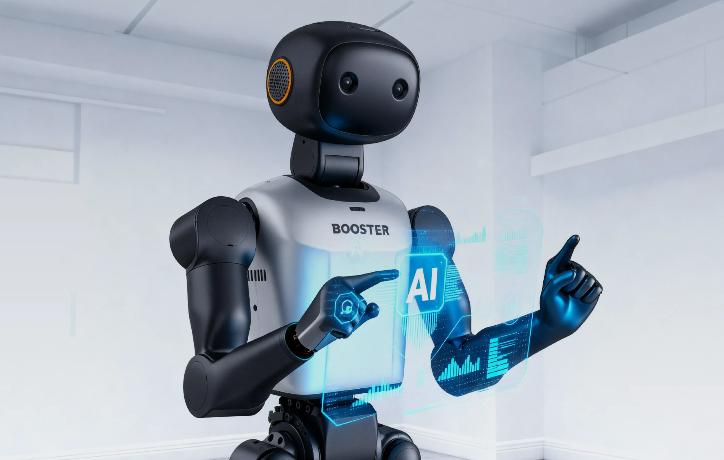
Stewie is built on the Booster K1 platform by Booster Robotics.
Stewie is built on the Booster K1, a platform made by Beijing-based Booster Robotics — founded in 2023 by engineers from Tsinghua University's robotics lab. The K1 stands 95 cm tall, weighs 19.5 kg, and has 22 degrees of freedom across its legs, arms, and head. It is designed for education, research, and interactive demonstration. At RoboCup 2025, K1-based teams took first and second place in the KidSize Humanoid League, including an 11-0 championship final.
Booster K1 — key specs
Height: 95 cm (3.1 ft) · Weight: 19.5 kg · Degrees of freedom: 22
Compute: NVIDIA Jetson Orin NX — 117 TOPS · Pro tier: Jetson AGX Orin 32GB — 200 TOPS + Doubao LLM
Starting price: ~$12,500 (Geek config)
RoboCup 2025 — KidSize Humanoid League: 1st and 2nd place, 11-0 championship final
Humanoids are about to become travel companions
As consumer humanoids move from commercial deployments into homes, a meaningful share of owners will travel with them — for work, for demonstration, for companionship. Social robots designed for sustained human interaction are not equipment in the way a laptop is. They are companions in the way a service animal begins to be. Airlines, hotels, rideshare platforms, and cruise operators were built to accommodate humans and their luggage. None of them have terms of service, liability frameworks, or operational procedures that account for a passenger who travels with a bipedal AI. That is the gap Stewie just walked through.
The policy infrastructure gap is the real story
Service companies now face a class of question their legal, compliance, and product teams have not worked through: What is a social robot's status on your property? Who is liable if it causes a trip hazard, collects ambient audio, or malfunctions near other guests? What does your privacy policy say about a robot with onboard cameras and a persistent voice profile? These are not edge cases. They are the standard operating questions for any company whose physical spaces will soon include robots that accompany people.
Airlines that figure this out first — with clear battery classifications, defined carriage conditions, and liability language built for robotic companions — won't just be ahead of the regulation. They will have written the template every other service industry is waiting for. The companies that wait for a regulator to define the terms will spend years retrofitting policies onto a reality that moved without them.
Stewie got a window seat. The industry got a preview.