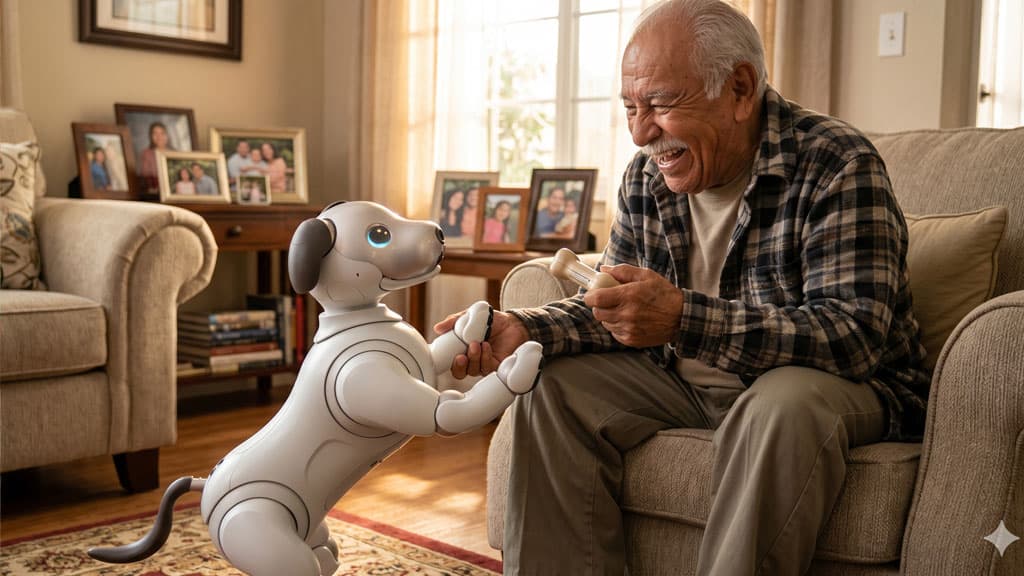
Colin Angle's new robot pet is a lesson in expectation management
Colin Angle — who co-founded iRobot and put the Roomba into 40 million homes — unveiled his next robot this week: a four-legged AI companion called the Familiar. It has doe eyes, bear-cub ears, and touch-sensitive fur. It makes animal sounds but doesn't speak. It follows you room to room and adapts its behavior over time by learning from what people say around it. And it was deliberately designed to look like nothing you've ever owned. That last decision is the one worth paying attention to.
The Familiar is four-legged, bulldog-sized, with doe eyes and bear-cub ears — not a dog, not a cat, not a human. Angle made that a design constraint, not an aesthetic preference. Every social robot that models itself on a known creature inherits the full weight of human expectation for that creature: a robot dog that doesn't fetch, greet, or follow commands the way a dog does will feel broken, even if it works exactly as designed. The Familiar sidesteps that failure mode entirely. There is no prior version for it to disappoint.
Maja Matarić — who has spent 25 years on socially assistive robotics — got down on the floor and hugged the Familiar within minutes of seeing it. Her word for what made it work was "vulnerable." A robot that appears to need something from you is a fundamentally different object than one that performs at you. Sustained engagement in human-robot interaction doesn't come from capability display — it comes from perceived relationship. The Familiar was designed for that dynamic, not for demo-floor impressiveness.
Angle's target users are retired people who want companionship but are deterred from pet ownership by the fear and obligation of care. That isn't a demographic reached for emotional resonance. It's a specific, underserved demand: the desire for the relationship without the dependency risk. Operations leads and product managers in healthcare and senior living should read this as a deployment signal — the Familiar's design intent maps directly onto assisted living environments and mental health support contexts where human staff carry unsustainable emotional load.
The US Census Bureau projects that by 2050, the population aged 65 and older will reach 83.7 million — nearly double the 43.1 million counted in 2012, and representing roughly one in five Americans. By that point, all surviving baby boomers will be 85 or older. That is a large, identifiable group growing into exactly the conditions Angle is designing for.
Six months ago, Angle says, he couldn't have built this. The capability that changed wasn't locomotion or materials — it was the AI's ability to understand ambient speech and adapt behavior over time. Before generative AI, a robot's behavioral range was fixed at manufacture. The Familiar accumulates a relationship. That shift — from static performance to adaptive companionship — is the difference between a toy and a presence.
Marc Raibert, Cynthia Breazeal, and Maja Matarić — the Familiar's advisors — share one position: skepticism toward humanoid robots that can't yet perform useful physical work. Their alignment isn't incidental. Angle built an advisory structure that validates the product's core thesis: that the human side of the interaction is where the real design work lives. The Familiar may or may not succeed commercially. But the decisions behind it — form factor chosen to eliminate expectation mismatch, vulnerability as an engagement mechanism, a specific demographic selected for unmet need — read less like product development and more like an applied HRI research program.