Robot Profile
Reachy Mini
An open-source desktop robot from Pollen Robotics and Hugging Face — a low-cost embodied AI platform for developers, educators, and researchers.
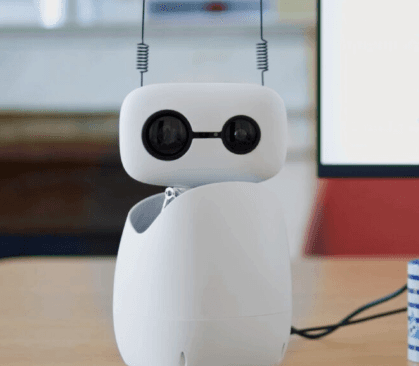
Robot Profile
An open-source desktop robot from Pollen Robotics and Hugging Face — a low-cost embodied AI platform for developers, educators, and researchers.
Overview
Reachy Mini is a compact, open-source desktop robot built by Pollen Robotics and brought into the Hugging Face ecosystem following the company's 2025 acquisition. At 28 cm tall and starting at $299, it is the most accessible entry point into embodied AI development — a physical interface for LLMs, voice agents, and multimodal AI workflows. Its six-degree-of-freedom head, rotating base, wide-angle camera, and four-microphone array give AI models a body to inhabit. Two versions exist: the Lite, wired and requiring a host computer, and the Wireless, which runs a Raspberry Pi 5 onboard and operates on battery. The human experience of interacting with Reachy Mini is largely what the developer makes it — but the platform's openness, deep Hugging Face ecosystem integration, and explicitly AI-native SDK make it one of the most consequential developer robotics launches in years.
RXD Score
Functional
3.00 / 5.0 — Functional


Field Images
Deployment Context
Operational Context
The robot sits on a desk or table, interacting at close range with one or a few people. It is not a mobile platform — it does not navigate or roam. Most interactions happen in developer workspaces, classrooms, or research labs, typically at seated eye level. The Wireless version can be moved between locations; the Lite version stays tethered to a host computer.
User Population
Primary users are technically proficient — developers working in Python and ROS2, AI/ML researchers exploring embodied interaction, and educators building robotics or AI curricula. Non-technical users, including students and demo audiences, encounter the robot as bystanders or in guided interactions. Their experience depends entirely on what the primary user has built into the robot.
Friction Points
Documentation is incomplete and APIs are still shifting between releases. Non-developer users hit a wall immediately — there is no onboarding layer for end users. When things fail, the robot goes silent. Nothing communicates what went wrong or what to do next. The gap between a configured, expressive robot and a freshly unboxed one is enormous and falls entirely on the developer to bridge.
Field Observations
Even with limited degrees of freedom, users project significant intent onto the robot. Antenna movement and head orientation alone were sufficient for observers to attribute curiosity, acknowledgment, and attentiveness — consistent with findings in low-DoF social robotics research. The "Pixar lamp" effect is real: timing and direction of motion matter more than mechanical complexity. When the robot speaks and looks toward the user simultaneously, perceived presence jumps noticeably.
Founding Cohort · May 2026
The first REP cohort runs the first week of May 2026. This is the only time the program will run at this rate — and the only cohort where founding members get direct access to the instructor throughout.
No engineering background. No prerequisites. Just the credential the field is missing.