Robot Profile
Unitree Go2 Pro
A consumer-priced quadruped from Unitree Robotics doing real commercial work — security patrols, crop monitoring, and inspection of environments unsafe for humans.
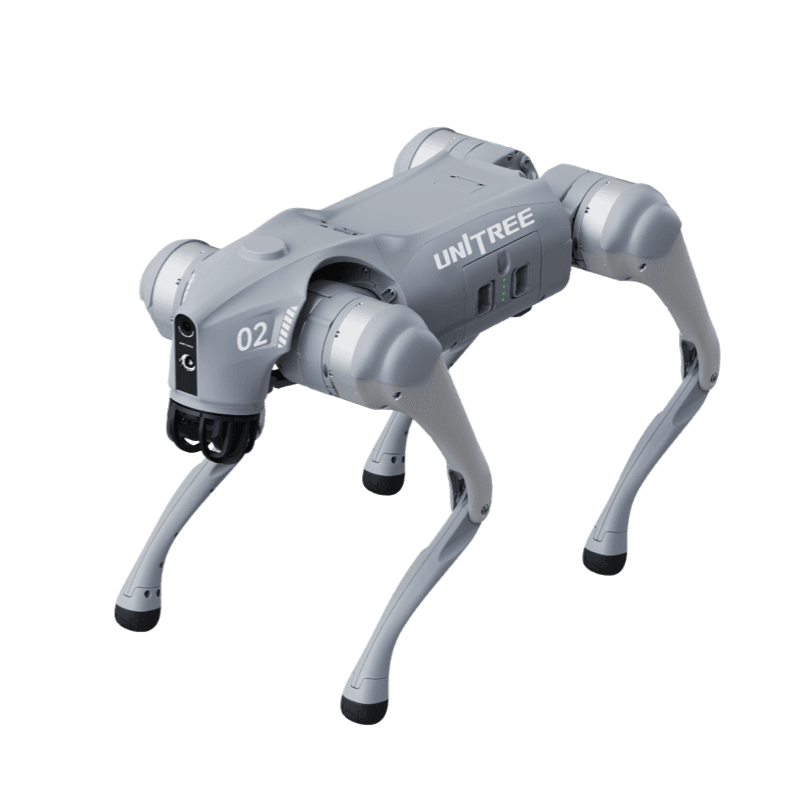
Robot Profile
A consumer-priced quadruped from Unitree Robotics doing real commercial work — security patrols, crop monitoring, and inspection of environments unsafe for humans.
Overview
The Unitree Go2 Pro is a 15 kg quadruped from Unitree Robotics that is arguably the first consumer-priced legged robot doing real commercial work — patrolling sites, monitoring crops, and inspecting environments unsafe for humans or animals. Twelve degrees of freedom, a 4D LiDAR with hemispherical coverage, and autonomous navigation from loadable 3D maps give it genuine field capability at a price point that was five figures away two years earlier. The human experience lags the mechanics: the robot communicates almost nothing about its state or intent to the people around it, so everything a bystander or handler needs to know lives in an app or in the handler's head. The Go2 Pro is what it looks like when locomotion is solved and legibility is not.
RXD Score
Developing
2.33 / 5.0 — Developing


Field Images
Deployment Context
Operational Context
The Go2 Pro works outdoors and in environments unsafe for humans or animals — security patrol routes, crop rows, inspection sites. It runs one to two hours per battery charge at speeds up to 3.5 m/s, navigating autonomously from 3D LiDAR maps that operators can pre-load as scans of the environment. Operators control it from a mobile app with a live HD camera feed at ranges beyond 30 meters, or hand it a route and let it run. Connectivity is 4G with GPS, Wi-Fi 6, and Bluetooth 5.2.
User Population
Primary users are trained operators — security staff, agricultural technicians, inspection teams — who work through the app, the remote, or graphical programming. They carry the operational knowledge the robot does not surface itself. Everyone else encounters the Go2 Pro as a bystander: workers on a patrolled site, people on farmland, passersby. They get no interaction channel and no signals to read beyond the robot's movement itself.
Friction Points
The front LED stays green regardless of what the robot is doing — it signals nothing about state or intent. With one front camera and a front-mounted LiDAR, sensing gaps cause collisions with objects, and with no microphone array the robot has no spatial sound awareness at all. Leg calibration drifts when the robot is powered off, and a miscalibrated restart is not surfaced by the robot — handlers discover it themselves and recalibrate from memory. Bystanders cannot tell where the robot is going next.
Field Observations
Roughly one hour of hands-on evaluation in a commercial deployment context. Mechanically the Go2 Pro is very solid — its balance is impressive, holding stands on front legs or hind legs without wobble. The design is deliberately honest: no tail, no face, clearly a robot rather than a fake dog, and non-threatening as a single unit — though a group of four or five would read as menacing. Real dogs split on it: some acknowledged the robot, others ignored it entirely. Every failure we observed was legible only through the operator app or the handler's prior knowledge, never through the robot itself.
Founding Cohort · May 2026
The first REP cohort runs the first week of May 2026. This is the only time the program will run at this rate — and the only cohort where founding members get direct access to the instructor throughout.
No engineering background. No prerequisites. Just the credential the field is missing.